
KINGSBURY · ANTS ON AN UPPER FLOOR
Pest Control Kingsbury
The floor level does not locate the colony.
An ant trail in a Kingsbury upstairs room can seem to suggest a nest inside the wall. Visible workers establish a route at that surface; they do not reveal the complete route or colony position.
- Map only the part of the route you can see safely.
- Mention food or moisture conditions without naming them as the cause.
- Keep shared and private openings under their proper permissions.
Tell us which opening and destination are visible through ordinary access.

A floor number is context, not a nest diagnosis.
Read the upstairs observation
Arrival at an edge
A window joint or service edge may be where workers become visible. It is not necessarily the nest location, and a high floor does not make a concealed route proven.
Movement towards a destination
Describe any accessible spill or stored supply involved. Addressing a known opportunity is practical, but does not assess the whole colony.
Other insects upstairs
An unidentified winged or crawling insect should not automatically inherit the worker identification. Keep its appearance and location separate.
Indoor ant identification can change the advice
Dark garden-ant workers
A worker may be foraging indoors from a colony elsewhere. The upstairs position does not prove an indoor nest. Describe the visible colour and outline without concluding that every dark ant is the same species.
Small pale workers
Pharaoh ants are a small pale species associated with heated buildings in the UK. A yellow or light-brown appearance raises an identification question; it is not enough to diagnose the species from a poor picture or claim it is present in Kingsbury buildings generally.
Colony behaviour
Some ant species can establish new groups through budding rather than the familiar outdoor mating-flight picture. That is one reason identification matters before a method is chosen. Do not disturb concealed material or repeat an unsuitable application simply to test whether the worker line changes.
Describe the route within authorised access
For the Kingsbury home, explain which room and building edges you control. Shared shafts or exterior fittings may require permission. The contact team can confirm identification assistance and a suitable available ant service.
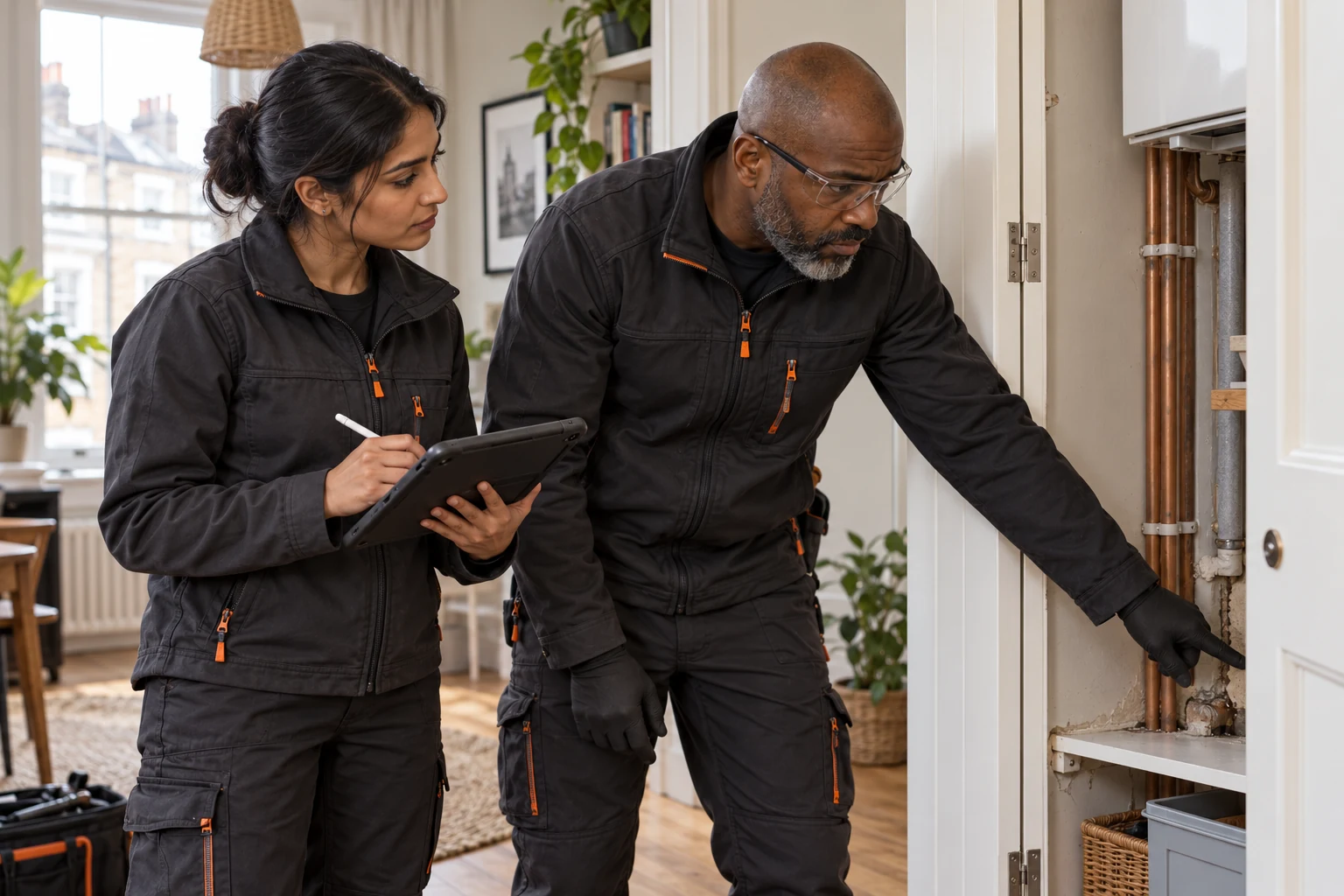
Do not open wall cavities or follow workers across unsafe exterior surfaces. An assessment should distinguish visible movement from a proposed concealed connection. Mention previous products and any maintenance at the relevant edge.
Choose the method after species clarification
An outside-foraging question
Accessible food opportunities and a visible route can guide practical changes. Ask what observations support that interpretation instead of assuming it from the insect’s dark colour.
A supported indoor species concern
Confirm appropriate assistance and method-specific preparation. Different ant biology can require different advice; the fact that a product worked on garden workers elsewhere does not make it suitable for every upstairs ant enquiry.
Arrange the upstairs brief
- Room, visible entry edge and destination.
- Any independent findings on other floors, separately labelled.
- Previous product placements and relevant repairs.
- Authorised access to shared or exterior features.
Quote for the supported locations
The price guide should be discussed with access and method in mind. Proofing addresses assessed defects, not the assumption that every upstairs worker comes through the nearest gap.
Different nearby ant questions
Queensbury considers workers returning after cleaning. Wembley offers another property guide.
Upper-floor ant questions
Assessment can use the accessible line without guessing every concealed connection.
Does the second floor prove the nest is indoors?
No. Floor level alone does not identify the colony’s position or route.
Can a service opening be part of a route without holding a nest?
Yes. The visible feature and the colony location are different questions.
Should exterior windows be climbed around to trace the line?
No. Describe the safe normal-access limit and discuss suitable assessment.
Do ants on another floor prove one connected colony?
Not automatically. Keep the observations distinct until identification and links are supported.
Is blocking the nearest gap a complete ant plan?
Closure alone may not address the identified concern and must respect building functions. Obtain appropriate advice.
Can a private booking include communal shafts?
Only with the necessary authority, access and expressly agreed scope.
Describe the floor without inventing a hidden nest
Getting Rid of Pests can discuss the Kingsbury route and the safe, authorised next assessment.